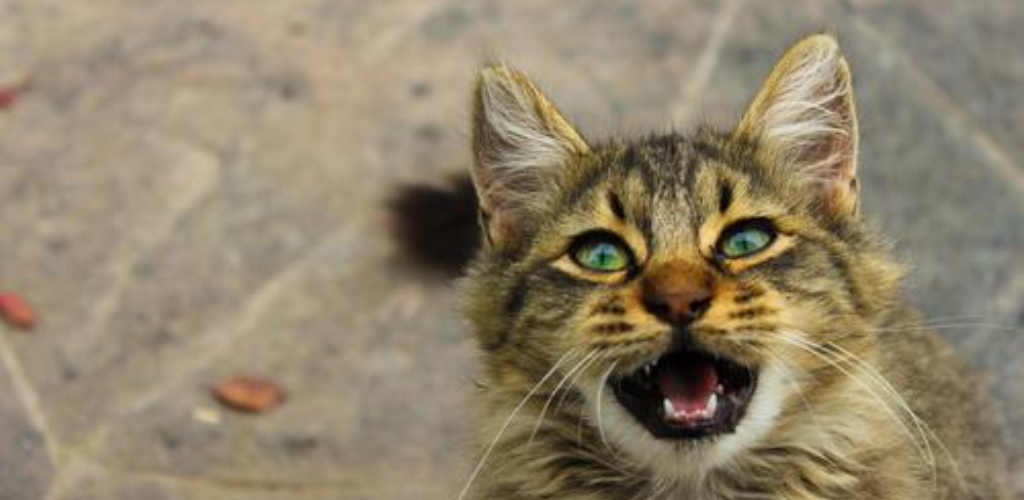
Felinologists claim that cats meow only for us humans. And they communicate with each other in a different, non-verbal way. So what do our pets tell us?
Let’s get acquainted with the cat “dictionary”.

– A short, monosyllabic “meow” simply means greeting. If this syllable is repeated several times, it means that you are very welcome.
— A long and prolonged “meow…” on a low note is a demand to do something, for example, to open the door. With the same signal, but on a low note, the cat expresses displeasure, and on a high note – pain or fear.
— A cat purrs, of course, when it is satisfied with life. But sometimes, when the animal is sick or nervous, purring is a kind of mantra, an attempt to calm itself down.
— Sometimes cats make some “quack” sounds, for example, if they fail to catch a prey – a fly or a bird, which, unfortunately, is out of reach. That’s how cats feel sorry.
— If a cat is going to defend itself from an enemy, it hisses warningly.
In addition to sounds, cats widely use sign language. And for us, people, it is more clear and unambiguous.
— The main place in cat gestures is occupied by the tail: If it is raised – the cat feels pleasure, if it also trembles at the same time – the purr is glad to see you. A tail raised and loose at the base means aggression, and if it is clamped between the hind legs, the cat is scared. A wag of the tail means thoughtfulness, and a strong wag means that the cat is very unhappy. In general, the use of the tail in non-verbal language is a distinctive feature of domestic cats: only our pets allow themselves to raise their tails, and all wild animals always lower it down or even hide it in their legs.
– If the cat came to rub against you, then this is how he shows his affection. This is how he “marks” his own. Characteristic rubbing against you with the whole body means a very affectionate greeting. It is interesting that if the animal rubs against you and the furniture in the presence of guests, it means that the guests did not like it and the cat shows that it is the master here.
— Sometimes cats sniff your face – it means that the animal has doubted whether it is you? If then there is an attempt to hide your head under your chin or under your armpit – the face control has been passed, you have been recognized.
— If the cat starts to lick you, then it recognizes that you are a member of the cat pride or that something delicious is left on you.
— But the highest manifestation of love and comfort is the “milky step” – when the cat stomps and “kneads” you with its paws, sometimes releasing and then retracting its claws.
Of course, happy cat owners know many more feline gestures and habits and understand their pets better than anyone. But how cats feel and understand us so well is a mystery.